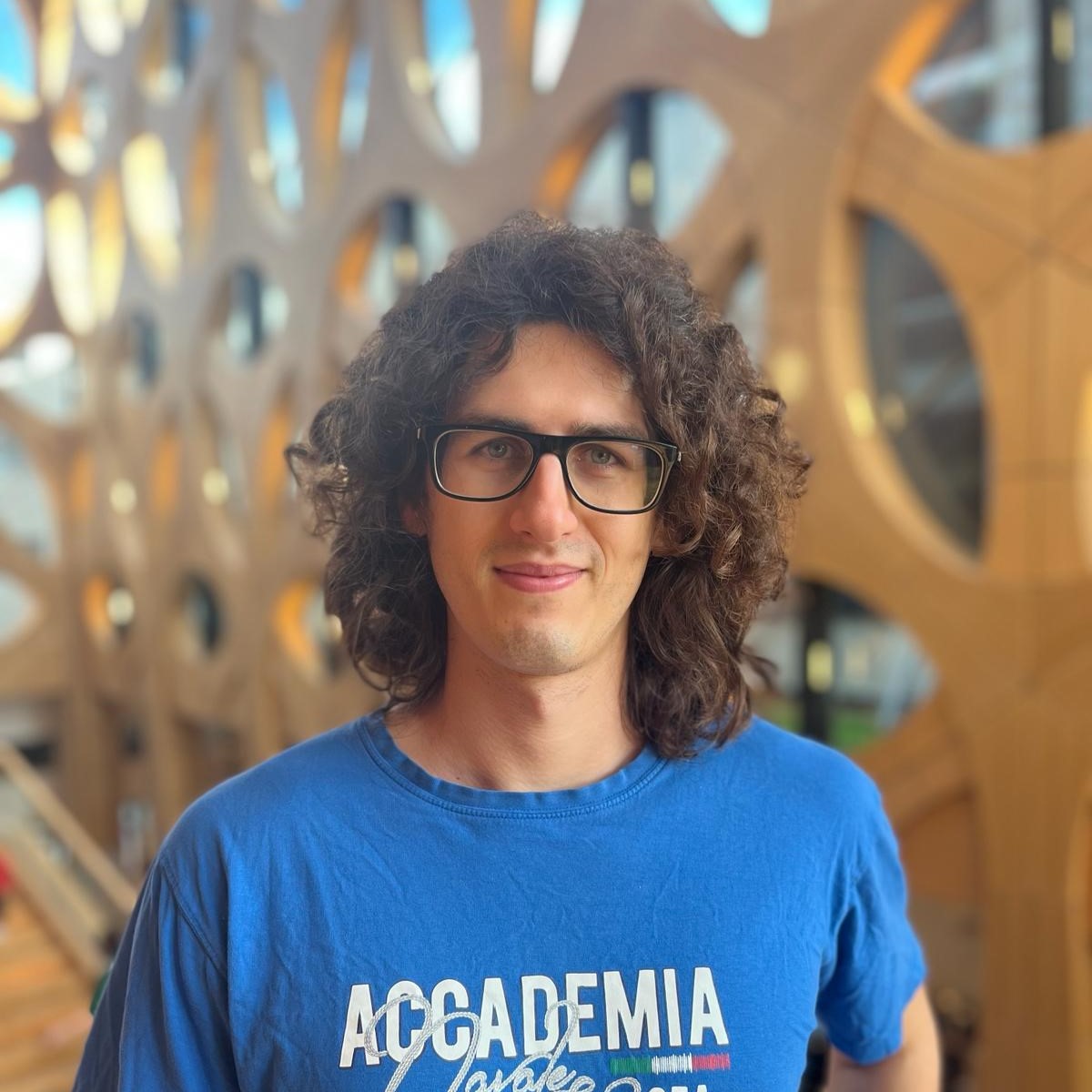
About me
I build open-source machine learning tools for targeted protein degradation and (sometimes) for materials property prediction and data extraction.
I’m a PhD student in the AI Laboratory for Molecular Engineering (AIME) led by Rocío Mercado, at Chalmers University of Technology in Gothenburg, Sweden, working at the intersection of AI, computational chemistry and drug discovery. Most of my work is about PROTACs: how to represent them, how to predict what they will degrade, and how to make the data and models behind those predictions genuinely reusable by other groups.
My path here ran from computer engineering through FPGA accelerators and two years in the aerospace sector, before an internship at AstraZeneca turned into a PhD. I’m always happy to talk about new ideas and collaborations — reach out 🚀
News
- August 2026LeMat-Synth v2 is out on arXiv, a multi-modal LLM/VLM toolbox that extracts synthesis protocols from scientific literature, together with a 58K-procedure inorganic materials synthesis dataset on Hugging Face. You can try it out on GitHub.
- June 2026Presented a TACK poster at the Machine Learning for Materials and Molecular Discoveries (ML2MD) symposium in Uppsala. Tingting Mo and Jia Xin Zhu also defended their MSc thesis on PROTAC synthesizability.
- June 2026Felix and Alex successfully defended their MSc thesis on generative modeling for PROTACs, congrats! 🎉 You can read more about it here and here the full thesis.
- June 2026Andrea and Tingting successfully defended their MSc thesis on assessing PROTAC synthesizability, congrats! 🎉 You can read more about it here and the full thesis.
- May 2026TACK was accepted at KDD 2026 (AI for Science Track) — a 3,514-PROTAC dataset and a statistical benchmark of degradation activity models. Data on Hugging Face.
- May 2026Submitted QT-Net: Rethinking Evaluation of AI Models in Atomic Chemical Space to NeurIPS 2026. Preprint on arXiv.
Research
Will this degrader work?
Models that predict PROTAC-induced degradation (pDC50, Dmax, binary activity) from structure, target and cellular context — and honest evaluation protocols for telling real progress from noise.
Reading PROTACs as modules
Automatically decomposing heterobifunctional degraders into E3 ligand, linker and warhead, so downstream models can reason about the parts rather than one opaque SMILES string.
Datasets others can build on
Curating, harmonising and releasing PROTAC data — because in this field a lot of apparent modelling progress turns out to be curation in disguise.
Selected Work
Everything below is open source, with data and trained models released alongside the papers. See all publications for the full list.
- TACK (KDD 2026) — 3,514 PROTACs and 6,561 degradation endpoints in one standardised dataset, plus a statistical benchmark showing that XGBoost and MLPs still beat a domain-specific GNN. Dataset · Code
- PROTAC-Splitter (Journal of Cheminformatics, 2026) — automated annotation of PROTAC substructures, with a synthetic corpus of ~1.3M annotated structures. Demo · Code
- PROTAC-Degradation-Predictor (AI in the Life Sciences, 2024) — an open, reproducible degradation activity model that outperforms DeepPROTACs at a fraction of the complexity. Demo · Code
I also supervise MSc thesis projects in this space — see Supervision — and present this work at conferences, summer schools and workshops, listed under Talks.
Career Path
Before AI “was cool”, I focused my studies on embedded systems, with a focus on computer architecture design and high performance computing. I’ve always been fascinated by both hardware and software, and I’ve worked on projects ranging from developing hardware IPs for RISC-V processors to FPGA-based accelerators in HLS for machine learning.
After working two years in the aerospace sector at Gaisler, I decided to pivot my career towards AI and computational chemistry instead. Thanks to an internship opportunity at AstraZeneca in Gothenburg, which introduced me to my current PhD supervisor, Rocío Mercado, I had the chance to work on a project that combined my passion for AI with my interest in drug discovery. This experience was a turning point for me and made me pursue a PhD in the field of AI-driven molecular engineering.
Please check my CV for more details on my education and work experience.
Collaborators
This work does not happen alone. I’m grateful to collaborate with Rocío Mercado, and my group at AIME at Chalmers, and with Eva Nittinger and Christian Tyrchan at AstraZeneca R&D Gothenburg — as well as with my former co-authors Pedro Trancoso, Ioannis Sourdis and Christos-Savvas Bouganis from my hardware years.
Funding. My research is supported by the Chalmers Gender Initiative for Excellence (Genie) and the Wallenberg AI, Autonomous Systems and Software Program (WASP), funded by the Knut and Alice Wallenberg Foundation. Computations and data storage are enabled by Chalmers e-Commons and the National Academic Infrastructure for Supercomputing in Sweden (NAISS), partially funded by the Swedish Research Council through grant agreement no. 2022-06725.
Miscellanea
- I love cooking and trying new recipes, sometimes in a very “nerdy” way (for example, I really love this book series 🥦)
- If you don’t speak Italian, somehow my name is very hard to pronounce right… so here is how to pronounce it correctly!
- For personal reasons, I happen to often travel to Leiden, in the Netherlands. If you’re around, we can also meet there in the lovely city center!