
TACK: A Statistical Evaluation of Degradation Activity on a Novel TArgeting Chimeras Knowledge Dataset
Published in 32nd ACM SIGKDD Conference on Knowledge Discovery and Data Mining (KDD), AI for Science Track, 2026
If a new PROTAC model beats the last one by two accuracy points, is that a real advance or noise? TACK was built to make that question answerable: a standardised dataset plus a statistically honest benchmarking protocol.
Abstract
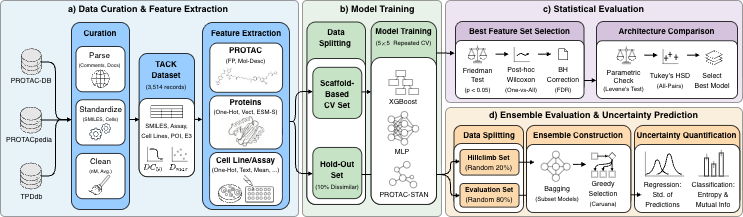
Proteolysis-targeting chimeras (PROTACs) represent a promising therapeutic modality that induces targeted protein degradation by hijacking the ubiquitin-proteasome system. We introduce TACK, a novel TArgeting Chimeras Knowledge dataset of 3,514 PROTACs and 6,561 degradation endpoints aggregated from three major repositories with standardized molecular representations, protein annotations, and experimental conditions. Using TACK, we perform a rigorous statistical comparison of three machine learning methods across three tasks: \(DC_{50}\) and \(D_{max}\) regression, and binary activity classification. Models trained on the best performing features show that potency (\(pDC_{50}\), \(R^2 = 0.66\)) is substantially more predictable than maximum degradation (\(D_{max}\), \(R^2 = 0.36\)). Statistical tests support that classical methods (XGBoost and MLP) significantly outperform PROTAC-STAN, a domain-specific graph neural network model (ROC-AUC: 0.85 vs. 0.74, \(p < 0.001\)). Feature ablation demonstrates that cellular context features and simple protein representations rival complex ESM protein embeddings, highlighting the importance of feature engineering over architectural sophistication.
Keywords: PROTAC, targeted protein degradation, benchmark dataset, statistical evaluation, XGBoost, protein embeddings, scaffold split
The Dataset
TACK aggregates and harmonises three major public repositories — TPDdb, PROTAC-DB and PROTACpedia — into what is, to our knowledge, the largest publicly available dataset for training and evaluating PROTAC degradation activity models:
| Property | Value |
|---|---|
| PROTACs | 3,514 |
| Degradation endpoints | 6,561 |
| Sources | TPDdb, PROTAC-DB, PROTACpedia |
| Standardised | molecular representations, protein annotations, experimental conditions |
The harmonisation step is the unglamorous part and also the load-bearing one: without consistent cell-line naming, unit conventions and protein identifiers, any cross-source comparison silently measures curation artefacts rather than chemistry.
Three Findings Worth Highlighting
- Potency is more learnable than efficacy. \(pDC_{50}\) reaches \(R^2 = 0.66\), while \(D_{max}\) stalls at \(R^2 = 0.36\). The two endpoints are not interchangeable targets, and papers that report only one are reporting the easier one.
- Classical models still win. XGBoost and a plain MLP significantly outperform PROTAC-STAN, a domain-specific graph neural network (ROC-AUC 0.85 vs. 0.74, \(p < 0.001\)). The comparison is made with scaffold-based cross-validation and proper statistical testing rather than a single split.
- Features beat architectures. Cellular context features and simple protein representations rival much heavier ESM embeddings — a useful result if you are deciding where to spend your compute budget.
Resources
- Dataset: ailab-bio/TACK on Hugging Face
- Code: github.com/ribesstefano/TACK
- Trained models: Zenodo, DOI 10.5281/zenodo.15691822
- Preprint: arXiv:2605.19579
Collaborators
Joint work with Nils Dunlop and Rocío Mercado at the AI Laboratory for Molecular Engineering (AIME), Chalmers University of Technology and University of Gothenburg.
Funding and acknowledgements. This work was funded by the Chalmers Gender Initiative for Excellence (Genie) and the Wallenberg AI, Autonomous Systems and Software Program (WASP), supported by the Knut and Alice Wallenberg Foundation. Computational resources were provided by Chalmers e-Commons and the National Academic Infrastructure for Supercomputing in Sweden (NAISS).
Citation
@misc{ribes2026tackstatisticalevaluationdegradation,
  title={{TACK: A statistical evaluation of degradation activity on a novel TArgeting Chimeras Knowledge dataset}},
  author={Stefano Ribes and Nils Dunlop and Roc{\'i}o Mercado},
  year={2026},
  eprint={2605.19579},
  archivePrefix={arXiv},
  primaryClass={q-bio.QM},
  url={https://arxiv.org/abs/2605.19579}
}
Recommended citation: Ribes, S., Dunlop, N., Mercado, R., "TACK: A statistical evaluation of degradation activity on a novel TArgeting Chimeras Knowledge dataset", 32nd ACM SIGKDD Conference on Knowledge Discovery and Data Mining (KDD), AI for Science Track, 2026. arXiv:2605.19579.