
PROTAC-Splitter: A Machine Learning Framework for Automated Identification of PROTAC Substructures
Published in Journal of Cheminformatics, 2026
PROTACs are modular by design, yet telling their modules apart computationally is surprisingly hard. PROTAC-Splitter automates that decomposition, turning a raw SMILES string into an annotated E3 ligand, linker and warhead.
Abstract
Proteolysis-targeting chimeras (PROTACs) are heterobifunctional molecules composed of an E3 ligase ligand, a linker, and a warhead targeting a protein of interest (POI). Despite their modular structure, accurately identifying and annotating these components is challenging and typically relies on manual curation and predefined substructure matching. To address data scarcity, we generated and openly released a synthetic dataset of approximately 1.3 million PROTAC structures with annotated ligand splits. Leveraging this dataset, we developed two complementary approaches for PROTAC substructure annotation: a Transformer-based sequence-to-sequence model and a graph-based XGBoost model. The Transformer model achieves high exact-match accuracy on public data, while a hybrid approach combining the strengths of both models reliably annotates PROTACs across diverse chemical spaces.
Keywords: PROTAC, targeted protein degradation, substructure annotation, Transformer, XGBoost, molecular graphs, cheminformatics, open data
Why This Matters
Almost every downstream PROTAC modelling task — linker design, warhead swapping, degradation activity prediction, synthesizability scoring — presumes you already know which atoms belong to which module. In practice that annotation is done by hand or with brittle SMARTS rules that break as soon as the chemistry drifts away from the well-trodden CRBN/VHL space.
PROTAC-Splitter treats decomposition as a learning problem instead of a matching problem, which is what lets it generalise to chemistry it has not seen before.
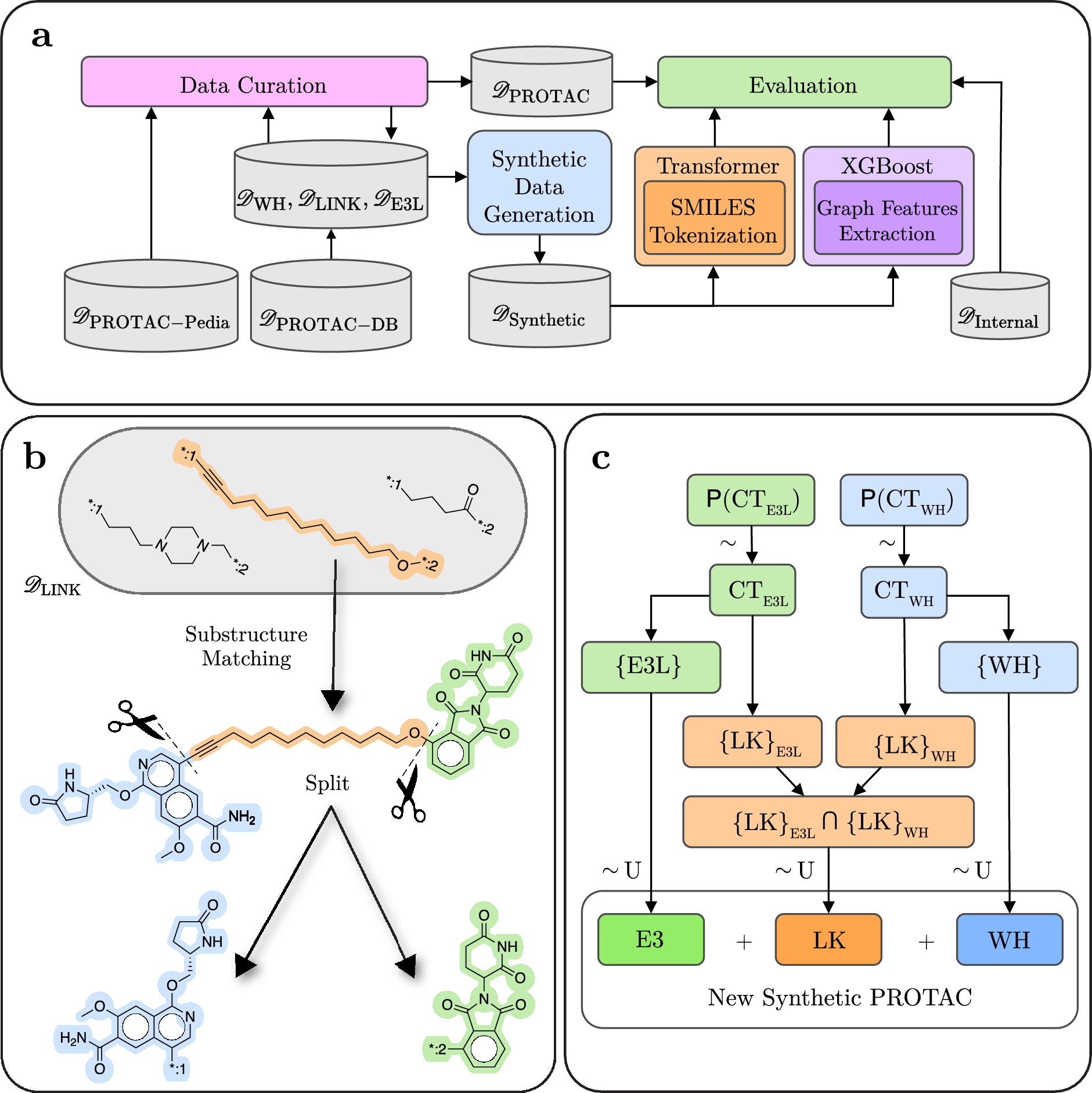
Approach
The framework has three moving parts:
- A synthetic corpus. Roughly 1.3 million PROTAC-like molecules assembled from known ligands and linkers, each carrying a ground-truth split. Releasing this openly is arguably as useful as the models themselves — labelled decomposition data simply did not exist at this scale before.
- A Transformer sequence-to-sequence model. Reads the PROTAC SMILES and emits the three component SMILES directly, reaching high exact-match accuracy on public benchmarks.
- A graph-based XGBoost model. Classifies bonds as cut/no-cut using graph descriptors, including a betweenness-centrality heuristic. It is far cheaper to run and degrades more gracefully on unusual chemistry.
An adaptive strategy combines the two, falling back from one to the other so that the framework stays reliable across chemical space rather than only on the molecules that resemble its training data.
Evaluation
We evaluated on both public PROTAC collections and a set of structurally novel internal PROTACs provided by AstraZeneca. The gap between the two is the interesting result: the Transformer’s exact-match accuracy drops sharply on the internal set, while the XGBoost model — lower-scoring on public data — holds up comparatively better. That contrast is exactly why the released tool ships the hybrid strategy as its default rather than the single best-on-paper model.
Code, Models and Data
- Source code: github.com/ribesstefano/PROTAC-Splitter
- Interactive app: PROTAC-Splitter on Hugging Face Spaces
- Datasets and trained models: Zenodo, DOI 10.5281/zenodo.15797309
Collaborators
This work was carried out in the AI Laboratory for Molecular Engineering (AIME) at Chalmers University of Technology together with Ranxuan Zhang, Télio Cropsal and Anders Källberg, and in collaboration with Christian Tyrchan and Eva Nittinger at AstraZeneca R&D Gothenburg. The project was supervised by Rocío Mercado.
Much of the framework grew out of Ranxuan Zhang’s MSc thesis, Machine Learning for PROTAC Decomposition and Enhanced Degradation Prediction (Chalmers, 2025), which I supervised — see Supervision.
Funding and acknowledgements. Stefano Ribes acknowledges funding provided by the Chalmers Gender Initiative for Excellence (Genie). Ranxuan Zhang and Télio Cropsal acknowledge funding provided by the Wallenberg AI, Autonomous Systems and Software Program (WASP), supported by the Knut and Alice Wallenberg Foundation. Computations and data storage were partially enabled by resources provided by Chalmers e-Commons, AstraZeneca compute resources, and the National Academic Infrastructure for Supercomputing in Sweden (NAISS), partially funded by the Swedish Research Council through grant agreement no. 2022-06725. Open access funding was provided by Chalmers University of Technology.
Citation
@article{ribes2026protac,
  title={{PROTAC-Splitter: a machine learning framework for automated identification of PROTAC substructures}},
  author={Ribes, Stefano and Zhang, Ranxuan and Cropsal, T{\'e}lio and
          K{\"a}llberg, Anders and Tyrchan, Christian and Nittinger, Eva and
          Mercado, Roc{\'i}o},
  journal={Journal of Cheminformatics},
  volume={18},
  number={1},
  pages={30},
  year={2026},
  publisher={Springer},
  doi={10.1186/s13321-025-01135-9}
}
Recommended citation: Ribes, S., Zhang, R., Cropsal, T., Källberg, A., Tyrchan, C., Nittinger, E., Mercado, R., "PROTAC-Splitter: a machine learning framework for automated identification of PROTAC substructures", Journal of Cheminformatics 18, 30 (2026).